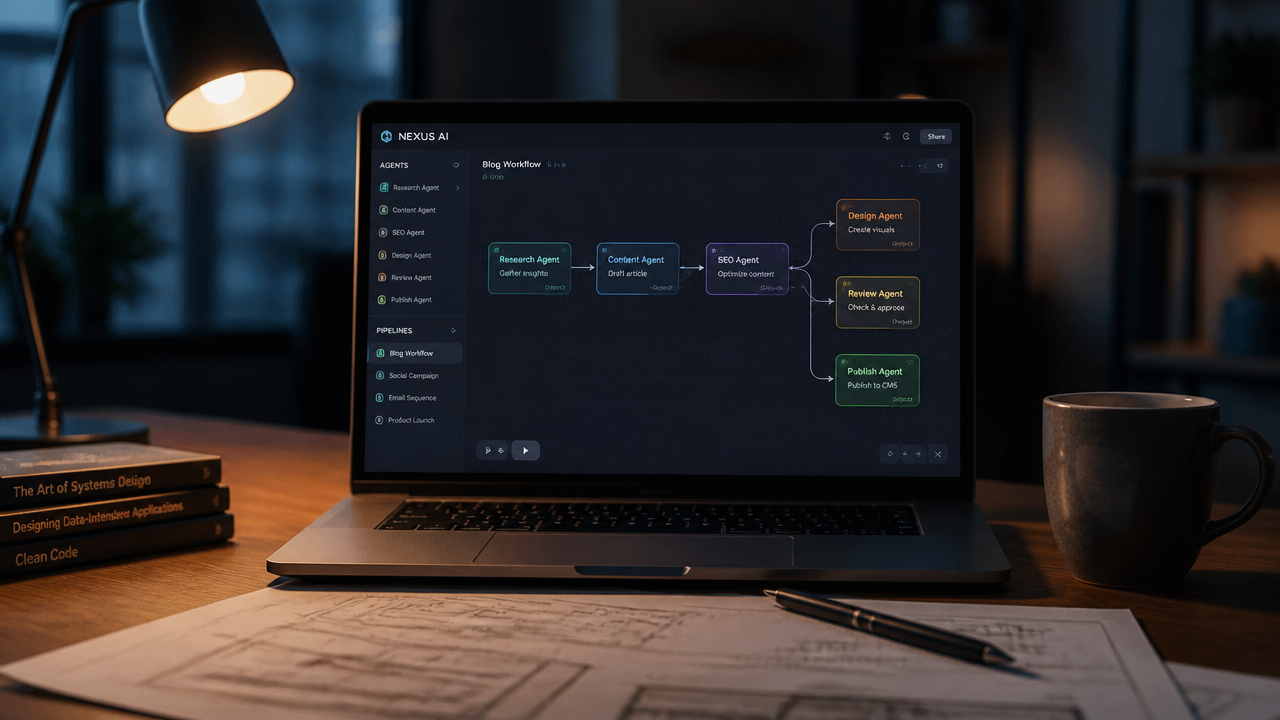
How to Build Autonomous Content Pipelines with OpenAI’s New Agents API for Content Automation
Table of Contents
- Architecting the Next Era of Content Automation
- How OpenAI's Managed Harness Solves Long Production Loops
- Building an Autonomous Content Engine with Custom Tools
- Human-in-the-Loop Reviews and CMS Publishing Systems
- Conclusion
Architecting the Next Era of Content Automation
OpenAI launched the Agents API in public beta on September 10, 2026, providing developers with managed session orchestration, context compaction, and subagent execution. Modern content automation is the practice of using software, managed APIs, and AI agent workflows to execute the entire blogging lifecycle from topic research and drafting to asset deployment and scheduled CMS publishing with minimal human oversight. For SaaS teams looking to expand output, content automation cuts down manual coordination while keeping full technical control over the final post. When we built publishing flows in the past, tracking state across multi-turn LLM calls required complex database logic and fragile memory wrappers. The new openai agents api shifts that harness infrastructure directly into a cloud-managed runtime.
Is Traditional Content Automation Being Replaced by AI Agents?
Traditional automation relies on rigid linear rules or basic triggers that fail whenever custom formatting or multi-step reasoning enters the picture. While simple webhook pipelines handle trigger-action steps reliably, ai agent workflows bring dynamic decision-making into your blog operations. Agents can research real-time search results, restructure drafts based on changing search intent, and handle technical code examples without breaking the execution flow.
How Can You Automate Content Creation End-to-End?
You start by pairing structured data triggers with an intelligent agent runtime. When you couple an autonomous agents framework with targeted tools, your system handles keyword mapping, outline building, article drafting, and final metadata preparation in one continuous loop.

How OpenAI's Managed Harness Solves Long Production Loops
In custom developer setups, multi-step text generation tasks often fail when context windows fill up or background workers drop active session state. OpenAI's public beta introduces durable sessions and context compaction directly into the endpoint layer. This means long blog production loops can run across multiple worker turns without losing earlier instructions or burning through unnecessary context tokens.
For our team, building an autonomous content engine became far easier once context compaction started summarizing historical conversational steps automatically while retaining core stylistic instructions. This architecture makes content ops automation significantly more reliable when generating technical tutorials, long-form guides, or localized updates.
| Approach | Context Management | Tool Integration | Multi-Agent Support | Maintenance Overhead |
|---|---|---|---|---|
| Custom Scripts | Manual database state tracking | Hand-coded API callers | Custom orchestration logic | High |
| Zapier / Webhooks | Stateless per step | Pre-built app connectors | Linear step-by-step triggers | Low (but rigid) |
| OpenAI Agents API | Managed session compaction | Native tool and MCP support | Subagent execution harness | Minimal |
Building an Autonomous Content Engine with Custom Tools
An effective publishing system requires real-time factual grounding and specialized tool access. The Agents API lets you connect web search, sandboxed execution environments, and Model Context Protocol (MCP) servers directly into your primary agent. This setup enables subagents to query live search indexes, verify technical facts against authoritative documentation, and run code validation routines before finalizing a draft.
Will AI Agents Replace Human Content Creators?
AI agents don't replace human creators. Instead, they shift the human role from manual drafter to strategic editor. By offloading research, initial drafting, and basic formatting to an automated system, editorial teams focus on brand positioning, product narrative, and high-level strategy.
When scaling your technical publishing stack, establishing SEO content production using webhooks and AI content engines provides a structured trigger layer that feeds clean briefs straight into your api blogging workflows.

Human-in-the-Loop Reviews and CMS Publishing Systems
Even the most capable agent setup benefits from human editorial guardrails. You can architect human-in-the-loop review steps directly inside your multi-agent execution harness. For example, a parent orchestration agent coordinates a research subagent and a drafting subagent, then pauses the active session to emit a review event to your internal dashboard.
Once an editor approves the draft, the session resumes and triggers downstream publishing calls. The agent formats the content into clean Markdown, attaches required metadata, and sends the payload to your CMS endpoints. Keeping your search rankings strong over time also requires ongoing maintenance, where automated content optimization helps prevent content decay and handles canonical rules across your published posts.
Conclusion
The release of OpenAI's Agents API gives developers the managed runtime needed to run persistent, self-healing content pipelines. By delegating session tracking and subagent orchestration to dedicated cloud infrastructure, product teams can build fast, reliable publishing workflows without managing complex custom state machines.
If you are ready to put these capabilities to work without spending weeks building custom harness code, visit AIrun.blog to set up your project and start generating scheduled, multilingual blog posts with the dashboard.